Applying Desmos to SAT problems
This will cover algebra 1 and 2 questions
In the xy-plane line k passes through the points$$(3,0)$$ and $$(0,5)$$. Which is the following is an equation of line K
- A. $$3x-5y=15$$
- B. $$5x+3y=15$$
- C. $$3x+5y=15$$
- D. $$5x-3y=15$$
Answer = B
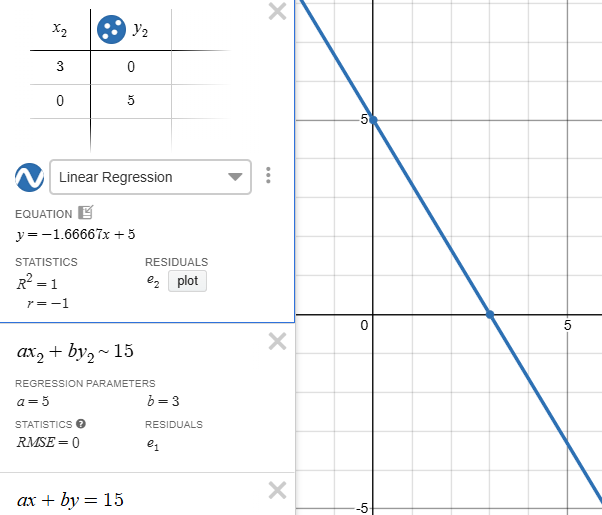
- Storing our data points in the table we can find the actual line and use our own regression.
- Note: We can safely set it equal to 15 as all answer choices = 15
- Double check by creating a similar equation with x1 and y1. If the equations overlapping then, they are right. If not you will have to manipulate the signs of a and b until the line overlaps
The solution to the given system of equation is $$(x,y)$$. What is the value of $$3x-5y$$?
$$x+4y=-3$$
$$4x-y=22$$
Answer = $$(5,-2)$$
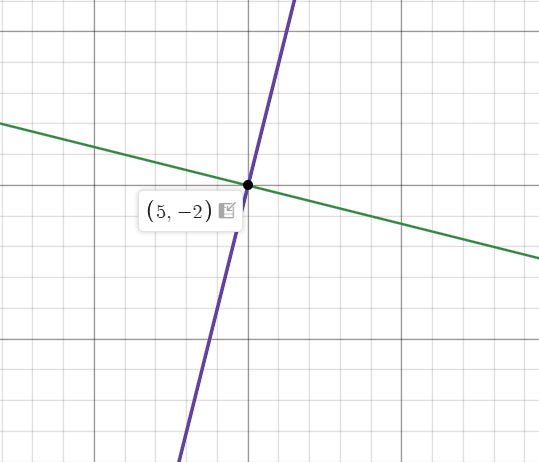
- Simply just plug in the equations
How many solutions does the given system of equations have?
$$0.5x+1.2y=9$$
$$1.5x+3.6y=27$$
Answer = $$infinite$$
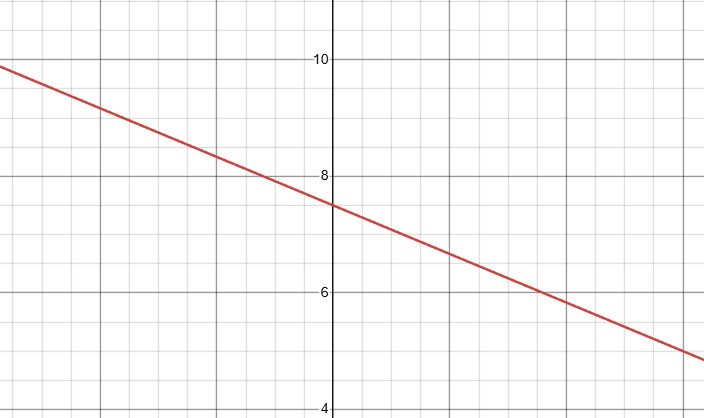
- Plug in the equations
- Since there is only one line that means the two lines overlap each other, so they have infinite many solutions as they are both the same line
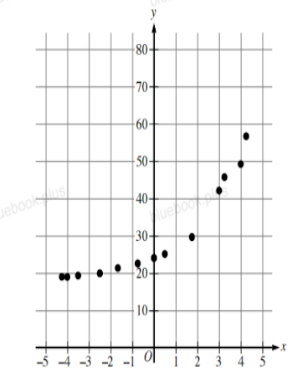
Which of the following equations is the most appropriate model for the data shown in the scatterplot
- A. $$y=24(1.55)^x$$
- B. $$y=24(1.55)^x+18$$
- C. $$y=(1.55)^x+23$$
- D. $$y=6(1.55)^x+18$$
Answer = $$D$$
.PNG)
- We can estimate points in the graph
- Using these points we can set up a regression, checking each possible answer to see which has a correct b value
Which of the following are solutions to the given equation, where a is a constant and a>25?
$$x-a = (x-a)(x-24)$$
- I $$a$$
- II. $$24$$
- III. $$25$$
Answer = I and III
- All we need to do is check each value of x to see which value will cause both sides to be equal to each other
- x is the same value as a here
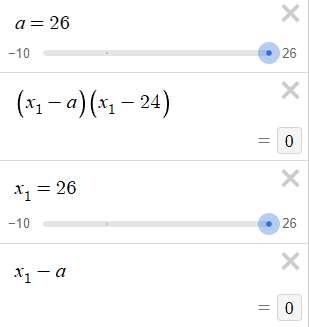
.PNG)
.PNG)
In the given equation, c is a constant. The equation has infinitely many solutions. What is the value of c?
$$18(x+5)=2(x+c)+16x$$
Answer = $$45$$
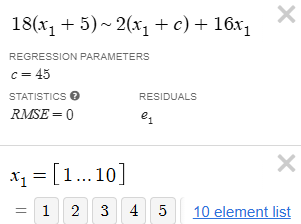
- We can plug in multiple for x1 into the regression to find c
3 coordinates pass through a quadratic function: $$(\frac{5}{9},0), (0,-120), (6,0)$$. The equation that represents this quadraitc relationship can be written as $$y=36x^2-bx-120$$, where b is a constant. What is the value of b?
Answer = $$196$$
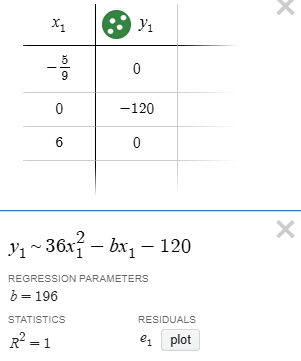
- Use the table and regression to find b
The function h is defined by $$h(x)=(x+p)(x-4)(2x-12)$$, where p is a constant. In the xy-plane, the graph of y=h(x) passes through the point$$(-2,0)$$. What is the value of h(0)?
- A. $$-48$$
- B. $$-2$$
- C. $$8$$
- D. $$90$$
Answer = $$96$$
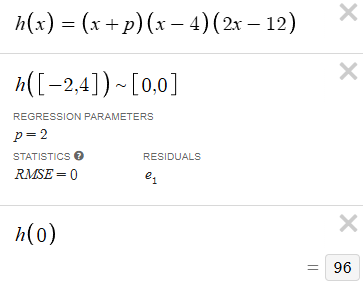
- We can use regression in this way as well plugging in elements into h(x) that will have to equal the corresponding elements to the right
- We can find p this way, letting us do h(0) in the end
The function f is defined by $$f(x)=24x^3$$. The graph of $$y=f(-x)+c$$, in the xy-plane, where c is a positive integer constant, has an x-intercept at (r, 0) and a y-intercept at (0, t), where r and t are constants. Which of the following must be true about r and t?
- A. r<0 and t>0
- B. r>0 and t>0
- C. r<0 and t<0
- D. r<0 and t<0
Answer = B
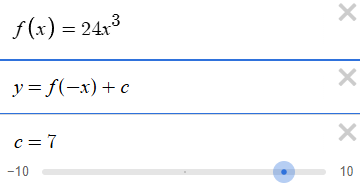
.PNG)
- Since we don't really have any other variable to manipulate we can use c.
- While useing the slider for c, the y-intercept and the root of the function will always be greater than 0
In the given equation,s and t are positive constants. The product of the solutions to the given equation is -2kst, where k is a constant. What is the value of k?
$$ \frac{1}{58}x^{2}+\left(s-\frac{1}{58}t\right)x-st=0$$
Answer = 29
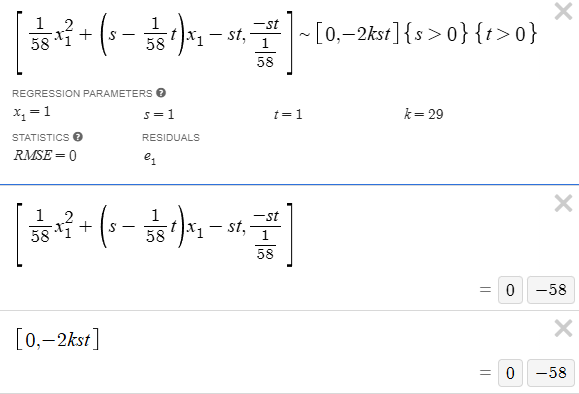
- We need to create another independent equation to find the unknowns, so we use the product of the solutions.
- The product of the solutions is equal to $$\frac{c}{a}$$, using $$ax^2+bx+c$$ format
- In this case c=-st and a = $$\frac{1}{58}$$
- Remember: you need to set constraints on s and t
The solution to the given system of equations is $$(x,y)$$. What is the value of $$8x+7y$$?
$$2(8x)+4(7y)=12$$
$$-2(8x)+4(7y)=12$$
- Now the x and y values we obtain as our solutions can be substituted into 8x+7y
- 8x+7y = 0 + 3 = 3
- Solving it regularly will get you 2.999999 which can be rounded to 3
Answer = 3
We can simplify this by saying 8x=x and 7y = y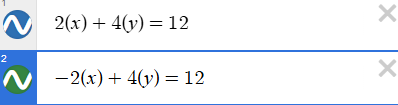
.PNG)
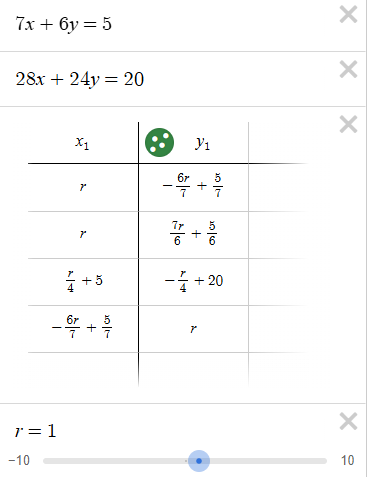
For each real number r, which of the following points lies on the graph of each equation in the xy-plane for the given system?
$$7x+6y=5$$
$$28x+24y=20$$
- $$(r, \frac{6r}{7}+\frac{5}{7})$$
- $$(r, \frac{7r}{6} + \frac{5}{6})$$
- $$(\frac{r}{4} +5, -\frac{r}{4}+20)$$
- $$(-\frac{6r}{7}+\frac{5}{7}, r)$$
- set r to some random number as it states "for each real number r"
- Plug in each coordinate until one lies on the line
- Only 3 points because one is far out
Answer = D
.PNG)
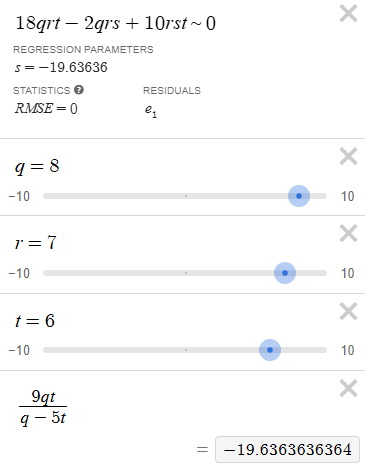
In the given equation, q, r, s, and t are positive, and are greater than 5. Which expression is equivalent to s?
$$18qrt−2qrs+10rst=0$$
- $$-\frac{9qt}{q-5t}$$
- $$\frac{9qt}{q-5t}$$
- $$18qrt$$
- $$\frac{2qt}{q-5t}$$
- To isolate just "s" we need to assign values to the rest of the variables whilst following the stated conditions
- After isolating just "s", we can just plug in each answer choice, finding the expression that matches the value of "s"
Answer = B
The function f is defined by the equation below for x≥0. K and b are positive constants and k < 1. Which of the following must be true?
$$f(x)=k^3(k^x)+b$$
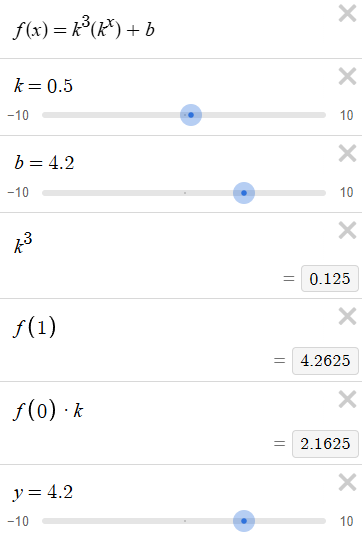
- The maximum value of the function is displayed as a constant or coefficient of the function.
- $$f(1)=f(0) \cdot k$$
- $$f(a) < b$$ for some $$a>0$$
- I only
- II and III only
- I and III only
- Neither I,II,III
- Looking x values ≥0, the maximum value must be the y-intercept, yet $$k, k^3$$ or b all are not equal to the y-intercept, so option 1 is wrong
- We can see that f(1) is not equal to f(0)$$ \cdot$$ k, so option 2 is wrong
- As the graph continues it will never equal 4.2 as there is a horizontal asymptote at y=4.2,so option three is wrong
Answer = Neither I,I,III
.PNG)
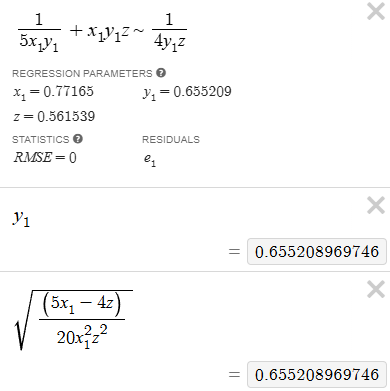
In the given equation, x, y, z are positive numbers. Which expression is equivalent to y?
$$\frac{1}{5xy}+xyz=\frac{1}{4yz}$$
- $$\frac{5x-4z}{20x^2z^2}$$
- $$\sqrt{\frac{5x-4z}{20x^2z^2}}$$
- $$\frac{1}{4xz^2-5x^2-z}$$
- $$\sqrt{\frac{1}{4xz^2-5x^2-z}}$$
- We can simply just plug it in
- Since we are looking for y, make sure to use the value of y1 rather than x1. The rest is just checking to see which answer choice equal y1
Answer = B