Intro to Regression
Regression, in essences, is a method for finding values of unknown constants so an equation can fit the given data points. Regression is especially useful on the algebra section as we can skip the tedious algebra work and obtain the value for the unknown variable that we need. Mastering regression should always be a top priority
Creating a regression
Before we look at regressions we should understand how variables work.
desmos has two kinds of variables:
- Infinite variables - x and y
- Definied variables - a, b, c, d, etc
Defined variables have specific values assigned to them like a = 2 while infinite variables will have an infinite list of values assigned for them. This is why $$y=2x+5$$ will create a linear line, yet $$y=2a+5$$ will be a vertical line as desmos will view the function as $$y=2(2)+5$$ rather than an infinite set of x values.
Regression requires defined variables instead of infinite variables as it needs specific data points.
Lets look at this example:
$$3\left(x-3\right)-11=4\left(x-3\right)+6$$
What value of x is the solution to the given equation?
While we can use basic algebra to solve for x to find x-3, instead, we can replace replacing x with x1, turning it into a defined variable, and use the surrounding constants to find x. To differentiate between an equation and regression we use the ~ sign.
Note: we can create x1 by inputting a 1 right after x. Desmos will automatically place the subscript.
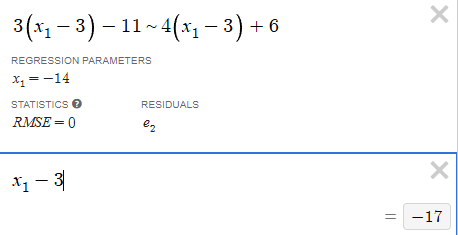
- Notice how we are instantly able to obtain a value for x1 that we can use to find x-3
Points and regression
Remember for x amount of constants you need to find, you should have x amount of data points for that function.
The previous example was a bit different in the sense that the surrounding constants acted at 1 data point for x1
Let's try this example:
The graph of the equation $$ax+ky=6$$ is a line in the xy-plane, where a and k are constants. If the line contains the points (-2,-6) and (0,-3). what is the value of k?
Although we are only looking for one constant since we have two unknowns we still need two data points
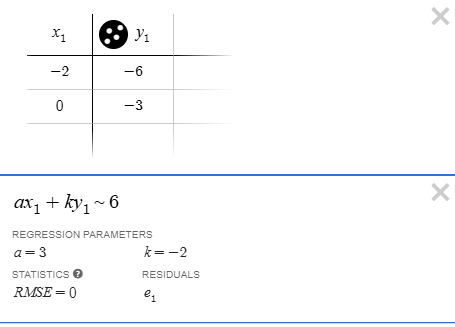
- We can use the table to store our data points as the coordinates will be set in (x1,y1) form
- Now we can simply plug in the equation using regression form. Make sure to use the defined versions of x and y as we are specifically pulling points from our table.
- Desmos will go through each coordinate and try to find and a and k that will fit the points.
Second Example
The cubic function $$y=(ax+3)(5x^2-bx+4)$$ passes through the points (1,21) and (2,132). What is the value of a and b
We have two unknown variables and 2 data points, so we can use the table function
.PNG)
Values from regression
Remember regression will take the closest absolute value number.
If we look at this equation:
- $$(x-1)^2+2=4$$
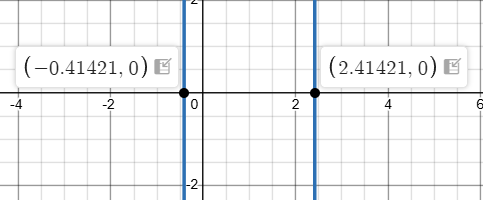
- The solutions are -0.414 and 2.414, but if we use regression, we will find the absolute value of the number closest to 0.
.PNG)
- The absolute value of -0.414 is closer to 0 than 2.414, so regression will use that and ignore 2.414. For questions where you might need multiple values of a constant, it is important to be aware of this.
Using List for regression
We can use lists instead of tables to store our numbers. We will call these numbers elements from now on.
The function y=mx+b is passes through the points (0,2) and (2,6). What are m and b equal to?
We can utilize the table, but let's try something different and create a list instead, storing the y's and x's as elements
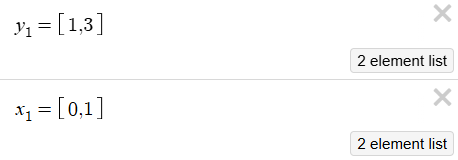
- We can put this into y=mx+b form now to get this:
- However, to make it clear about what is happening we can replace the defined variables with the lists.
- The first element on the left is assigned to the first element on the right and everything else with it, looking like this 1=(0)m+b. The same goes with the second element: 3=(1)m+b
.PNG)
.PNG)
Undefined regions of regression
If you are using random values of x1 to make sure your answer is correct to not include values of x1 that will cause an undefined region error
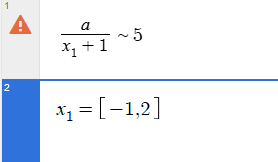
- Any number except -1 within the list will provide an answer for "a"
- This is because when x1=1 the denominator is 0 causing this error